
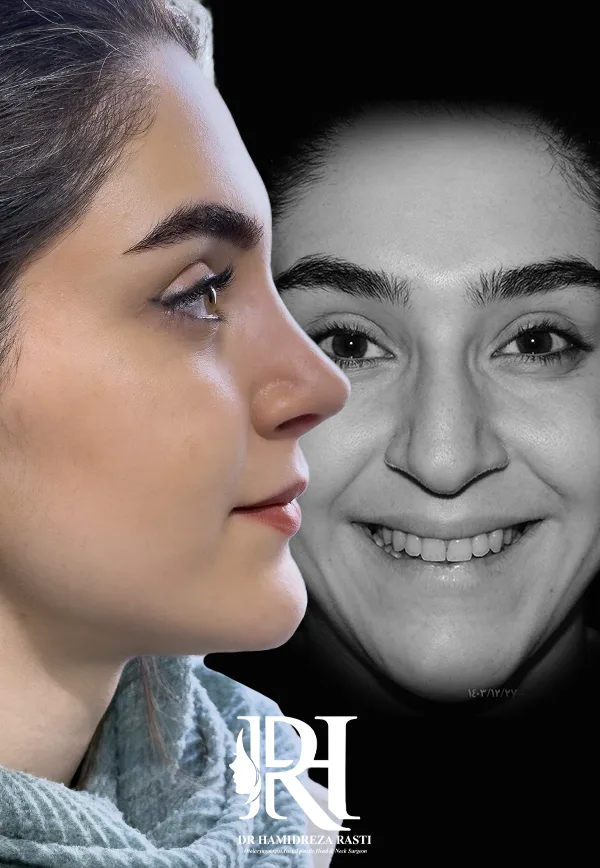
Natural Rhinoplasty
Rhinoplasty in a natural style is suited to people who don't want anyone to notice they've had cosmetic surgery. In this approach, the shape of the nose is refined so that it stays fully in harmony with the rest of the face — without an exaggerated arch, without an overly upturned tip, and without a "Barbie doll" look. The goal isn't to look "more beautiful" in an obvious way; it's to look more balanced with the person's own face.
Key Features of a Natural Nose
In this style, the bridge is given a gentle curve, the tip isn't left drooping but also isn't pushed up too far, and the bony areas aren't shaved down more than necessary. For women, a very soft curve is usually planned, while men typically get a straighter profile. The key point is that everything is designed around the individual's own facial anatomy — not copied from a photo of some actor or model.
Who Is the Best Candidate for This Surgical Style?
If you have delicate facial features, thin nasal skin, and a bony nasal structure, you're more likely to end up with a natural-looking result. But even with thicker, more fleshy nasal skin, a natural and well-proportioned shape is still achievable with the right technique and realistic expectations.
Dr. Hamidreza Rasti, an ENT surgeon with extensive experience in facial plastic surgery, uses the most modern methods for natural nose shaping at his clinic on Daftari Sharghi Street in Tehran. In particular, with the latest generation of piezosurgery devices, the nasal bone can be reshaped with greater precision and fewer complications. This technology helps reduce tissue damage, results in less pain, and leads to noticeably lighter bruising after surgery.
Why Is Natural Rhinoplasty More Difficult?
It might seem that, because the goal isn't a dramatic change in appearance, this kind of surgery should be easier — but the opposite is actually true. In natural rhinoplasty, every millimeter of change has to be made with great precision so the nose ends up refined into a delicate, harmonious shape without ever looking unnatural.
This calls for a deep understanding of facial proportions, nasal anatomy, and considerable experience in facial design — an area in which Dr. Rasti has a high level of skill.
Conclusion
If you're looking for a natural nose that doesn't draw attention and suits the shape of your face, this style of rhinoplasty is the best choice for you. Just keep in mind that success with this type of surgery depends heavily on choosing the right surgeon and using up-to-date techniques.
Are you a good candidate?
Your goal, medical condition, anatomy, and expectations for the result should all be reviewed together in an in-person evaluation.
What is a common mistake?
Deciding based only on one portfolio photo, or comparing yourself to someone else, can create unrealistic expectations.
Why does choosing the right surgeon matter?
A good outcome is not just about appearance; preserving function, safety, and a proper aftercare plan are also part of the treatment.
What Does a "Natural" Result Mean in Rhinoplasty?
"Natural" isn't a fixed number or angle. The goal is harmony between the nose and the rest of the facial features, avoiding the telltale signs of surgery, and preserving or improving the airway. Research on facial proportion shows that numerical measurements alone don't predict how satisfied a patient will be; so the design process should start with a careful conversation about the patient's expectations and an individualized facial analysis.
| Feature | Natural-Result Approach |
|---|---|
| Nasal bridge | Line and height proportioned to the forehead, chin, and gender — not necessarily fully straightened or given a pronounced arch. |
| Nasal tip | Rotation and projection proportioned to nose length and lip position, rather than forcing the same pattern onto every face. |
| Nostrils and alae | Corrected only when needed, with attention to symmetry and scarring risk; narrowing them further doesn't always produce a more natural result. |
| Breathing | Assessing the septum and nasal valves is part of the plan; appearance and function need to be evaluated together. |
Who Is a Better Candidate?
Someone with a clear, achievable goal, who accepts the natural limits of their own skin and cartilage, and who isn't insisting on a result that looks exactly like someone else's photo, generally has a more realistic decision-making conversation. AAO-HNS clinical guidance emphasizes reviewing motivation, expected outcome, and conditions such as body dysmorphic disorder, bleeding disorders, and breathing problems.
Natural, Semi-Fantasy, or Doll-Like?
These names are general style descriptions and don't have one single, standardized medical definition. The choice should be based on the structure of the face and nose, not simply a style label. For a more detailed comparison, see the page on the difference between a natural nose and a doll nose and the guide to natural versus semi-fantasy rhinoplasty.
What Should Be Clarified During the Consultation?
- Which feature of the nose is bothering you, and which feature should be preserved?
- Is there nasal congestion, mouth breathing, snoring, or a history of trauma?
- How much do skin thickness and cartilage strength limit how refined the result can be?
- Which changes would be unrealistic or would carry a functional risk?
- What is the expected recovery timeline, and how will results be followed up?
Medical sources: AAO-HNS clinical guideline on nasal form and function; study on facial proportion and satisfaction after rhinoplasty; comparison of patient and surgeon perspectives in aesthetic analysis.
Take the next step with an initial evaluation
Enter your name and mobile number; your file will be created in our system and you'll be moved to the booking page.